2. The Rules of Australian Football
- Huh? There are Rules?
- Playing Field and Equipment
- Players and Positions
- Player Uniforms
- The Umpires
- Scoring
- Starting and Restarting Play
- Marks
- Out of Bounds
- Possession and Disposal of the Ball
- Holding the Ball Rule
- Shepherding
- Free Kicks
- Kick-in after behind
- Play On
- Relayed Free Kicks
- Why are umpires 'booed' off the ground?
- What is the crowd yelling?
- Reports
- The List
- Coaches and runners
- Trainers
- AFLX Rules
"Huh? There are rules?"
Casual viewers of Aussie football often get a false impression of brutal anarchy from watching it, and some Aussies don't mind perpetuating that (Foster's Lager's TV definition of touch football: a series of "king hits" ending in the Eagles' Dean Kemp face down and unconscious). But there is a rule book. The rules have been evolving since 1858, and the end result is an athletic challenge like no other. Even in the modern era, the AFL sees fit to tinker with and modify the rules on an annual basis. (We also have the AFL rule book on this website here but we don't recommend this as a way for novices to understand the game because it's akin to trying to learn baseball by reading the official baseball rule book. Great for officials, bad for novices. We also have another Q&A on the sport and some videos which may help you.)
Measurements
All measurements and distances in Aussie Rules are given in meters (m). One meter = 1.1 yards approximately. To convert measurements from meters to yards just add 10 percent to the measurement.
Playing Field and Equipment
The Field
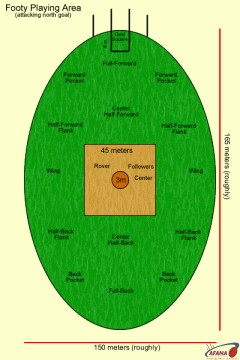
Unlike other games of football Aussie Rules is played on cricket ovals; thus, there are no standard dimensions for a football field (usually called "ground" or "paddock"). The field should be an oval between 135 and 185 meters in length and 110 and 155 meters in width. (The Melbourne Cricket Ground is considered an ideal surface; its dimensions are 160m length by 141m width.) The boundary is marked with a white line drawn a few meters from the stands.
The goals are two sets of posts erected at the far ends of the oval; the boundary forms a straight line through the posts. The inner set of posts is the goal posts, 6.4 meters (7 yards) apart, and at least 6 meters tall. Two behind posts are set 6.4 meters from the inside of each goal post, and must be at least 3 meters tall. All posts must be padded to a minimum height of 2.5 meters. This is a precautionary measure so players are not severely injured if they collide with one of the posts (it does happen).
A goal square (actually a rectangle) extends 9 meters into the ground from the goal posts, and is 6.4 meters in width.
A radius is drawn on the oval 50 meters from each goal. This merely serves as a range finder; most AFL players can kick a goal from this line, and perhaps beyond.
The center circle is marked at the precise center of the oval, 3 meters in diameter, bisected by a lateral line extending 2 meters either side of the diameter, and dividing the field in half. An outer circle, 10 meters in diameter, and a center square, 50 meters on each side, are both centered on the center circle. These markings control the conduct of center bounces, as will be seen later.
An interchange area, 15 meters wide, is usually located on the wing of the field.
Ground Sizes
As we stated above, there is no standard size for an Aussie Rules ground. The table below shows the sizes of all grounds currently used by the AFL. Measurements are from goal to goal and boundary to boundary:
-
Sydney Cricket Ground (SCG) 155m x 136m
Spotless Stadium - Sydney 164m x 127.5m
ANZ Stadium - Sydney 160m x 118m -
Etihad Stadium (formerly Colonial Stadium and Telstra Dome) - Melbourne 159.5m x 128.8m
-
Adelaide Oval 167m x 123m
-
Wollongabba Cricket Ground (the "Gabba") - Brisbane 156m x 138m
Metricon Stadium - Gold Coast 161m x 134m -
Melbourne Cricket Ground (MCG) - Melbourne 160m x 141m
-
Manuka Oval - Canberra 162.5m x 138.4m
-
Optus Stadium - Perth 165m x 130m
-
Aurora Stadium - Launceston, Tasmania 170m x 140m
Blundstone Arena (Bellerive Oval) - Hobart, Tasmania 160m x 124m -
Skilled Stadium (formerly Kardinia Park/Shell/Baytec Stadium) - Geelong, Victoria 170m x 117m
-
TIO Stadium - Darwin, Northern Territory 175m x 135m
TIO Traeger Park - Alice Springs, Northern Territory 168m x 132m
Cazaly's Stadium - Cairns, Queensland 165m x 135m
The Ball

The ball is an oval latex bladder covered with smooth leather, tanned for day use or colored visible yellow for night matches, and inflated to 62 kPa (9 psi) to 76 kPa (11 psi) pressure. It closely resembles a Rugby football.
Length 270 - 280 mm (10.62 - 11.02 inches), Diameter 167 - 173 mm (6.57 - 6.81 inches)
Circumference - 720 - 735 mm ( 28.34 - 28.94 inches) by 545 - 555 mm (21.46 - 21.85 inches), Approx. weight (Dry weight inflated ball.) 450 - 500 grams (15.88 - 17.65 ounces)
Before each match, the home club must submit at least two new balls to the umpires for their approval. The visiting club then selects one of them as the game ball. This ball is expected to be used throughout the game; it's tradition today, but was usually necessary in the early years. As in soccer, the ball comes back when it goes into the crowd.
Players and Positions
A team consists of 18 players; four interchange players and one substitute player are allowed on the bench. The substitute was introduced from the start of 2011 season. He wears the green vest at the start of the game and cannot enter the field of play or rotated while wearing the green vest. At any time during the game, he may be substituted for one of the players in the team. He takes off his green vest, and the player he replaces wears the red vest and sits on the bench for the rest of the game. Teams can only do a single substitution during the game. A player may be substituted for injuries or tactical reasons, and can also be temporarily substituted for up to 20 minutes during which he undergoes a concussion test.
Due to the faster pace of today's game some coaches are pressing to have the number of interchange players raised to six. During the preseason competition, when the weather can be quite warm, a 6 man interchange is allowed. A team may play with as few as 14 players on the field, but playing "shorthanded" is almost unheard of in the AFL.
There are no restrictions as to how often each player can be rotated on and off the bench, however the total number of rotations for the entire game must not exceed 90 (it was reduced from 120 in 2016). There is a designated interchange area from which players must enter and leave the ground with an interchange steward to ensure excess players do not enter the field of play.
Early in 2008, an incident which saw an extra player being on the ground momentarily led the AFL to introduce stricter rules regarding the interchange. The new rules required clubs to submit a written request for a player to be interchanged with another. That request would be recorded by the interchange steward and would then have to be approved by the steward before the player could enter the field of play. Grounds also now have a designated square painted in yellow on the sidelines where the players wait to enter the field of play. After the initial trial, many clubs complained that the new process was too slow and, on several occasions, left them one player short on the field while the steward completed the paperwork. The AFL then revised the rules and employed their official statistics company, Champion Data, to record all interchanges. The stewards, who have access to the information provided by Champion, no longer have to accept and approve interchanges nor do clubs have to await approval to interchange players.
Clubs are required to submit information to the interchange steward: the numbers of the four players named to the bench (as well as the substitute); the numbers of the five players on the bench at the start of each term (including the substitute); the number of any player stretchered off due to injury; the number of any player who leaves the arena for any reason, and the player to be replaced when the substitute is activated. Clubs may be fined if they fail to provide the necessary information to the steward, if a player leaves the interchange area prematurely even if he does not enter the field of play, or if a player does not enter or leave the field through the interchange area.
Player positions
Players are considered deployed in five lines of three across the oval, with the remaining three assigned to the ball.
The players in each line are usually designated as being in either the left, center or right position in each line, relative to the direction of attack:
| Full Forwards: | Left Forward Pocket | Full Forward | Right Forward Pocket |
| Half Forwards: | Left Half Forward Flank | Center Half Forward | Right Half Forward Flank |
| Center Line: | Left Wing | Center | Right Wing |
| Half Backs: | Left Half Back Flank | Center Half Back | Right Half Back Flank |
| Full Backs: | Left Back Pocket | Full Back | Right Back Pocket |
The three assigned to the ball are referred to as "followers." Their positions are referred to as Ruckman, Rover and Ruck-Rover.
Although the players have designated positions, they are free to move anywhere on the ground when play is in progress; there is no "goalie" in Aussie Rules. They also move farther and faster as the years go by; during a match in 1998, Channel 7 put a high-tech tracking device on Kangaroos rover Jason McCartney (retired in 2002) to follow him through a game, and found he ran over 26,000 meters - more than a half-marathon.
Purposes of player positions
All players should contest the ball when its within their vicinity (unless playing to alternative coaching instructions). Other general purposes of player positions according to line are:
| Forwards: | Attack the goal |
| Trap the ball in the area | |
| Half Forwards: | Attack the goal |
| Set up scoring shots | |
| Trap the ball further forward - then hold | |
| Trap the ball in the area | |
| Center Line: | Attack the goal |
| Set up scoring shots | |
| Recover the ball from the back line | |
| Trap the ball further forward - then hold | |
| Trap the ball in the area | |
| Half Backs: | Hold the ball in the area |
| Attack - clear ball forwards | |
| Recover ball from backline | |
| Backs: | Hold the ball in the area |
| Attack - clear ball forwards |
Player Uniforms
Each team wears jerseys (uniform shirts with "V" necks which used to lace up, and collars) in cotton-polyester blend, shorts and knee socks of identical club colors and design. The jersey may either be sleeveless or long-sleeved, according to player preference. Each jersey bears a different oversized number on the back, to be visible from the stands; numbers have no relationship to position or function as they do in NFL football.
Teams wear white shorts when playing away from their home ground for easier identification. In the 2000s, the AFL has been encouraging clubs to come up with alternate designs to avoid "color clashes" when two teams with similar jerseys (Richmond and Essendon, Collingwood and North Melbourne) play each other, and now all 18 AFL clubs have introduced separate away jerseys. New designs will also increase sales of jerseys to fans. The boots (football shoes) are usually low-cut turf shoes with studs or cleats, in designs and brands that would be familiar to players of other forms of football.
No body armor is worn. Mouth guards, soft protective headgear, thigh pads, shin guards, and joint strappings (such as shoulders and ankles) are permitted. Other protection or medical appliances require prior approval; generally, you can't play in a cast or heavy knee braces as you can in the NFL, unless protective padding is added to reduce injury risks. Jewelry is prohibited as a health hazard; even plain wedding bands can inflict damage if they punch another player instead of the ball. Players with a penchant for body piercing, like now retired Carlton player Glenn Manton, must remove the adornments for a game.
The Umpires
There are four field umpires, who have full control of the game. Major responsibilities of the field umpires are to start play, award marks and free kicks, and generally enforce the rules of the game. In carrying out their responsibilities, the field umpires each control roughly one third of the ground. The umpire in the area where the ball is currently being disputed is the umpire in charge at any one time, however either of the other field umpires may bring attention to infringements of the rules that occur 'behind the play'. Field umpires may signal each other to transfer control.
The two boundary umpires judge when the ball is out of the playing area, and also return the ball to the center of the ground after a goal has been scored. The boundary umpires patrol one side of the ground each. They take positions at diagonally opposite corners of the center square when the ball is bounced in the center square at the start of each quarter or after a goal is scored. At the center bounces, the boundary umpires are responsible for detecting players who enter the center square illegally. If a score looks imminent, such as from a set kick by a player, a boundary umpire will sometimes position himself near the posts to act as an extra pair of eyes to assist the goal umpire.
The two goal umpires signal, and record all scores in a match. Two flags are waved to indicate a goal, and one flag is used to indicate a behind. The flags are waved to indicate the score to the other goal umpire; the opposite goal umpire is expected to echo the signal to verify its receipt. The goal umpire also indicates to the field umpire what the score is by indicating with one finger for a behind and two fingers (one out-stretched on each hand) for a goal. Before the goal umpire can indicate the score, the field umpire signals to him that no infringements have occurred ("all clear") so that a score may be added. The field umpire will also indicate what he or she thinks the score is by cupping one or both hands around the mouth when calling "all clear" - one hand for a point, two hands for a goal, or hands behind the back if unsure and leaving the decision solely to the goal umpire. This is why the goal umpire looks around sometimes before signaling a score. At other times, the "all clear" may be obvious, and the goal umpire will tap his own chest with his hand to take authority for himself.
Field umpires cannot alter a decision once it has been made, except by a further breach of the rules by a player or team official. Goal umpires can correct mistakes prior to restart of play. Goal umpires take precedence over boundary umpires in the vicinity of the goal area. The goal umpire indicates this to the boundary umpire by tapping his chest.
Umpire uniforms were white for many years. These were modified to include a red and blue diagonal stripe and AFL logo on the front and blue numbers on the backs. Goal umpires became quite familiar even to the novice viewer in their white "lab coats" and hats, but those have long since been abandoned.
In 2005, the AFL altered the umpire uniforms so they would stand out against teams in similar colors. Umpires now wear green, orange, or yellow shirts and socks, and black shorts for field and boundary umpires and black slacks for the goal umpires. Goal umpires now also wear baseball caps to match the color of the day.
Starting and Restarting Play
A game is divided into 4 quarters of 20 minutes playing time. Time is kept off the field by two timekeepers. The scoreboard clock counts upward continuously from 0:00, and is entirely unofficial. When play is unduly delayed, such as the ball going out of the playing area, time is added on to the playing time of the quarter. This is referred to as 'time on'. The timekeepers activate a siren to signal the start and end of each quarter. The field umpires signal when they are ready to restart play so the timekeepers know to restart the clock.
Teams determine the initial choice of goal to kick to by coin toss. The winning captain usually chooses so that the wind will be behind his attackers for the first and third quarters. The teams change ends at the end of each quarter.
The field umpire in charge of the center bounce will raise the ball over his head as an indication to the timekeepers that he is ready to start play. He then bounces the ball in the center circle so that it rebounds vertically to be contested by the players in the center square. This is known as the "bouncedown." If ground conditions won't allow the ball to bounce, the umpire simply tosses the ball into the air as if it were a "jump ball." This is also done after a goal is kicked, to start each quarter or term, or when the umpire recalls the ball if he believes the bounce does not allow the ball to be contested. If the field umpire in charge of the center bounce awards a free kick to a player before bouncing or tossing the ball, he will signals "time on", blow his whistle and give the ball to the player.
At a center bounce, no player may enter the center circle or cross the center line into the opponent's side of the ground. Four players from each team are permitted in the center square, one of whom is allowed to be within the 10 meter outer circle, until after the ball has been bounced.
A maximum interval of 6 minutes is allowed between the first and second quarters, and between the third and fourth quarters, for the teams to change ends. Half-time is a maximum of 20 minutes long, with players being allowed to leave the ground for not more than 15 minutes. If the game is being televised, the broadcaster may prevail upon the umpires to increase the length of the breaks to allow more time for advertising, as is common practice in American professional sports.
Coaches may not have direct access to the players during play. The coaches generally confine themselves to a box above the ground, the senior coach having access to the bench through a field telephone. A runner (the guys dressed in neon green or yellow t-shirts and shorts) is used to relay instructions to the players.
After a goal is scored, play is restarted in the center of the ground in the manner described above.
The other common situations when play is restarted are:
(a) After a behind has been scored. Any player of the defending team kicks the ball from within the kick-off 'square' in front of goal. Previously, the designated kicker had to wait until the goal umpire waved the flag. However, in 2006 a new rule was introduced so players no longer have to wait. The player must kick the ball or run out of the goal square to restart play. You may observe, however, that there is no rule preventing him from kicking the ball to himself. In 2021 a new rule allowed players to leave the confines of the goal square before kicking, when this occurs the umpire will call 'play-on'.
(b) After the ball has gone out of bounds (outside the boundary line). If the ball went over the boundary line on the fly as a result of a kick that was not touched, it is "out on the full", and the opposing team receives a free-kick from the spot at which the ball went out. The closest player from the opposing team takes the free kick. The free kick may also be given if the umpire decides the ball has otherwise been put out of bounds deliberately. If a player makes insufficient attempt to keep a ball in play, a kick will be awarded against that player. Otherwise, the boundary umpire restarts play by throwing the ball back over his head toward the center of the ground.
(c) When a pack of players prevents either team from gaining clear possession, or a player being tackled or held fails to dispose of the ball ("holding the ball;" see "Possession" below). The umpire tosses the ball in the air, at the spot where play came to a halt.
Each quarter runs for 20 minutes of playing time -- when the ball is in play. The ball is considered out of play in the following situations:
(a) A goal is scored. Time is stopped from when the goal umpire finishes waving the flags to when the ball is bounced.
(b) A behind is scored. Time is stopped from when the goal umpire finishes waving the flag to when the ball is kicked in.
(c) The ball goes out of bounds. Time is stopped from when the ball goes over the boundary line until the boundary umpire throws the ball back into play.
(d) Whenever the field umpire signals to the timekeepers that time is to be stopped by raising one arm and blowing the whistle.
Scoring
A ball kicked over the goal line between the two larger goal posts by an attacker (without being touched) is a goal and scores six points. The ball is returned to the center circle for a "ball-up." There is no possibility of an "own goal" as in soccer.
If the ball passes over the goal line between the behind posts by any other means, then it is a behind, and it scores 1 point. If the ball hits the goal post, a behind is scored. This is regardless of where the ball goes after hitting the goal post, e.g., back into the field of play, through the goals or whatever. The ball is kicked back into play from the goal square. When the kick-in player runs out of the goal square without kicking the ball, the umpire calls 'play on'. The player (usualyy the full back) must then kick or hand ball before being tackled.
If the ball hits a behind post without bouncing it is deemed "out on the full" and the opposing team takes a free kick from next to the behind post. If the ball bounces and hits the behind post then the ball is thrown into play again by the boundary umpire from next to the behind post (see (b) under "Starting and Restarting Play" below). In either case, no points are scored.
The team scoring the most points wins the game. The match is considered drawn if points are equal.
If a finals match ends in a draw, an extra 10 minutes is played with the sides swapping goal ends after 5 minutes. Regardless of who scores when, the full 10 minutes is played out, unlike extra innings in baseball in which whoever scores first wins the game. If the Grand Final ends in a draw, the game is replayed one week later.
Marks
The most efficient way to move the ball down the field or to score is to get a "mark". It's also the most spectacular aspect of the game (hence the term "speccie"). If a ball is kicked and any player (of either team) catches the ball in the air that constitutes a mark. The ball cannot touch the ground before caught. The kicks are somewhat similar to "punts" in American football and for this reason, many Australian football players are making the jump to American football. When a player gets a mark, opposing players cannot get closer to them than the place on the field where the mark was awarded and the player can back up a sufficient distance to get a clear kick. If the player is within distance of their goal, they can kick for a goal. If not, they will try to kick to another player of their own team. If the quarter or game ends, and the player has a chance to kick a goal, they are permitted to complete the kick after the siren sounds.
Out of Bounds
A ball that has gone completely over the boundary line is considered out of bounds. If any portion of the ball is on or over the boundary line, the ball is still in play, as it is in soccer. A player can be over the boundary line and in possession of the ball without the ball being considered "out of bounds" if part of the ball is still in play.
Possession and Disposal of the Ball
A player may hold the ball for unlimited time when he is not being held by an opponent. However, the umpire has the discretionary power to tell the player to "get on with it" or in the parlance of the game: "play on" if he feels the player is taking too much time and is delaying play.
A player lying on or over the ball is considered to be in possession.
A player running with the ball must bounce the ball or touch it to the ground once every 15 meters. (The distance is usually not strictly enforced, especially if the runner is challenged.)
A player in possession of the ball and held by an opponent must dispose of the ball immediately by kicking the ball or a handball. (Tackling is permitted, but only between shoulders and knees.) (See next section.)
To handball correctly, a player must hold the ball in one hand and hit it with the clenched fist of the other hand. The hand holding must not move relative to the player's body. (Correct technique is sometimes more honored in the breach than in the observance.) Overhand passing is not permitted.
A mark is allowed when the ball is caught from a kick which has traveled a minimum distance of 15 meters, and the ball has traveled in the air without being touched by another player. (The ball usually doesn't have to be held for very long, especially in a physical marking contest; and yes, anything goes as long as both contestants "have eyes for the ball".) The player taking the mark may play on immediately, or go back and kick over the position where he took the mark. If he opts to play on, he is fair game to be tackled. If he opts to stay put and take a kick, no opposition player can touch him.
An illustration of an improper disposal:
Holding the Ball Rule
in the earliest days of Australian football, players were not permitted to use their hands. Through much of the 1860's, some players preferred a more soccer style game with just kicking the ball while others preferred rugby style with minimal ball handling. Eventually these rules were modified to allow players to pick up the ball - but only after it had bounced once on the ground. For many years, captains acted as umpires and in 1855, they agreed that players could run with the ball, In 1874, the rule was introduced whereby a a player with the ball had to drop it when tackled. This made the ball fair game for any player to get a boot to it. Field umpires were appointed in 1869 but there still was no holding the ball rule, except that a player had to drop it when tackled. Players were allowed to run with the ball but no more than necessary to kick it if they were not tacked before their kick.
Over the years, rules were dropped, added or amended. In 1906, a committee met to lay out another set of rules. Rule 14 stipulated in part, "... In cases of doubt or scrimmages, he (the umpire) will bounce the ball where the occurrence took place." In July 1930, the dropping the ball rule was amended again prohibiting the player from dropping the ball when tackled. Instead he was required to kick it or handball it. The rule proved unpopular and was repealed two months later. That didn't last and it was amended again in 1939, reverting back to the rule introduced in 1930.
Of course, the rules have continued to evolve as the game has become faster and more athletic. It is unclear when umpires began bouncing or throwing the ball up when it was locked up by players. However, one rule remains: the player in possession of the ball must make an attempt to dispose of it by hand or foot when in danger of being tackled. If he does not, the umpire rules "holding the ball" and awards a free kick to the opponent. If the player in possession is running with the ball, is tackled, and in the process of being tackled drops the ball, it is still holding the ball. If a player accepts the ball from a teammate and is immediately "wrapped up" or gang tackled by opposition players, it is up to the umpire to determine if the player had any reasonable opportunity to dispose of the ball. If not, the umpire will then toss the ball up on the spot where it happened. When a player goes to ground in a tackle, he must try to get the ball out. If he clings to the ball or drags it under him during the tackle, it is also a "holding the ball" offense.
Most of the time, the offense is obvious. Every once in awhile it can be a 50-50 decision, depending on the umpire.
Shepherding
A player may retard the movement of an opposition player towards that of the ball however it may only be done within 5 meters of the ball. Shepherding allows the opposition player to be pushed in the chest or side, or for the player to place his body between the opposition and the ball (when the player himself is not in possession of the ball.) Comparable to screens in basketball or blocking in American Football.
Free Kicks
The general principles of the rules are as follows:
- Keep the ball moving.
- Any player who goes after the ball will get every opportunity to take it.
- Any player caught with the ball will get a reasonable chance to dispose of it.
Fouls stem from violations of these principles, and the penalty for most violations is a free kick.
Free kicks may be given against players either with or without the ball. A free kick is generally taken at the spot where the infringement occurred. (Exceptions see "Play On" and "Relayed Free Kicks" below.)
A free kick is given against the player in possession of the ball for the following infringements of the rules:
(a) Not disposing of the ball within a reasonable time when held by an opponent.
(b) Not disposing of the ball correctly by using a handball or a kick.
(c) Kicking the ball over the boundary line without it bouncing first or being touched by another player.
(d) Deliberately forcing or taking the ball over the boundary line, or not making sufficient effort to keep the ball in play.
(e) Running more than 15 meters without bouncing the ball or touching the ball on the ground.
(f) deliberately dragging the ball under him while on the ground in a pack situation.
(g) deliberately kicking, handballing or forcing the ball over the attacking team's goal line or behind line, or onto one of the attacking team's goal posts when not under physical pressure from opposing players. This is given against the player of the defending team.
A free kick is given against any player who:
(a) Grabs the opponent with the ball above the shoulder (see 'Clarification of high tackles' below) or below the knees .
(b) Pushes an opponent in the back.
(c) Trips or attempts to trip an opponent.
(d) Charges an opponent, or makes forceful contact by leaping in the air when attempting to block or smother a kick.
(e) Interferes with an opponent attempting to mark in the air by punching the player, bumping or interfering with the marking player's raised arms.
(f) Interferes with an opponent by forcefully pushing or fending to the extent that the fend is a 'strike', including the situations where a player is trying to gain separation for the purposes of contesting the ball.
(g) Tackling in a dangerous manner where the player is driven into the ground with excessive force, including when this occurs in run-down tackles.
(h) Shepherds an opponent when the ball is more than 5 meters away.
(i) Enters the center square before the ball is bounced at the restart of play.
Following a free kick or mark, a 50 meter penalty is given against a player standing on the mark who:
(a) Refuses to stand on the mark at the point indicated by the umpire by calling 'stand', including running to a more defensive position when the umpire has called 'stand'.
(b) Deliberately wastes time in returning the ball to the player who is to take the kick, including not throwing the ball directly to the player.
(c) Holds the player who is to take the kick thereby preventing play continuing.
(d) Runs over the mark or into the 'protected area' around the kicker before or as the ball is kicked. (Any player in the opposing team can give this penalty). If a player from the kicker's team enters the 'protected area' an opposition player may follow that player without penalty.
Clarification of High Tackles
In 2022 the AFL provided further clarity to the judgement of free kicks related high tackles. The aim of the clarification was to not reward players for putting themselves in vulnerable positions to draw a free kick.
a) Where the tackle is reasonably applied, there is no 'prior opportunity' to dispose of the ball and the ball carrier is responsible for the high contact via a shrug, drop, or arm lift - 'play on' should be called.
b) Where the tackle is reasonably applied, and there is 'prior opportunity', and the ball carrier is responsible for the high contact via a shrug, drop or arm lift - 'holding the ball' (HTB) should be called and the tackler will receive a free kick.
c) If a player has their head over the ball and trying to gain possession and contact is high, a free kick for a high tackle (HT) will be called.
The following table explains how the rule is applied:
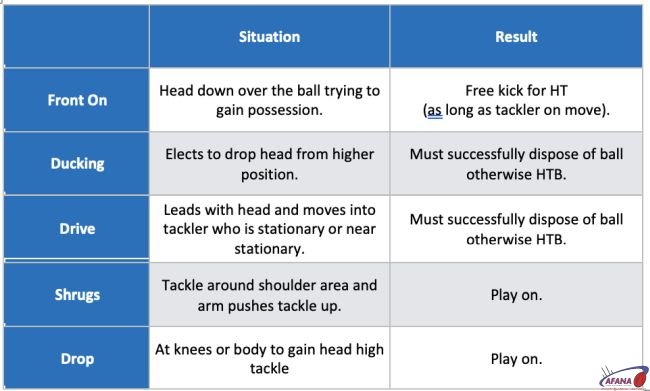
If 'play on' is called the ball carrier must successfully dispose of the football to avoid 'Holding the Ball' being paid against that player.
Kick-in after behind
If a ball is kicked back into play from the goal square, following the scoring of a behind, and subsequently goes "out of bounds" without being touched by a player of either team despite bouncing, it is treated as if having gone out of bounds on the full. The attacking team is awarded a free kick.
Play On
An umpire need not hold up play by awarding a free kick to a player who has been infringed. Where the player or a teammate has possession and is in an advantageous position, the umpire calls 'play-on' and allows play to continue. This is referred to as 'paying the advantage'.
Relayed Free Kicks
A player who is infringed upon, immediately following the disposal of the ball, may have a fellow teammate take the free kick from the spot where the ball landed after being disposed of. This is at the umpire's adjudication.
Why are umpires 'booed' off the ground?
In a large proportion of matches, whenever the umpires leave the field at half-time or the end of the match, the majority of the crowd will 'boo' them as they leave. Although more prevalent at games where the home team is losing (lost) and received controversial umpiring decisions against them, that doesn't explain this common action. Some propose that it comes from Australians' anti-authoritarian feelings as an ex-convict settlement that leads supporters to generally dislike umpires. While this theory sounds good from a sociological point of view the real truth of the matter, as any true footy supporter will tell you, is that all umpires are either blind, incompetent or biased, or any combination of these. Any free kick or penalty paid against a team earns the umpire abuse from one section of the crowd and applause from the rest. Definitely a 'no win' situation.
What is the crowd yelling?
In a case where there are a large number of supporters behind a team, they will try and influence the umpires decision by subtly, or in some cases not so subtly, bringing to attention any infringements of the rules. This advice is, of course, only offered by supporters of the team whose player is being infringed upon.
"MAN" - or "holding the man" not in possession of the ball
"HIGH" - when one of your players receives a high tackle
"BACK" - when one of your players is pushed in the back
"BALL" - when one of the opposition players is caught "holding the ball" or when the ball is locked up by a pack of players, in which case the fans are calling for a ball up.
"BULL..."- when the umpire misinterprets one of the above.
"WEED" - Adelaide Crows supporters shouted this out whenever Wayne Weideman had the footy. Weideman has since retired.
"WOOF" - Used by Carlton fans when Ang Christou gets a kick; mimics the sound made by a strong boot.. Christou retired several years ago.
"ROOOS" - Used in Sydney in support of Paul Roos. Retired in 1997 and was senior coach of Sydney from 2002 to 2010, leading the Swans to the 2005 Premiership. He became senior coach of Melbourne in September 2013 but resigned at the end of 2016 season.
"BOOO" - Once widely used against former Carlton centerman Greg Williams. Retired 1997.
"BREUST" - Used by Hawthorn fans when Luke Breust catches the ball or kicks a goal. He made his debut in Round 8 of 2011 season and was a member of the club's 2013, 2014 and 2015 Premiership teams.
Reports
There is no send-off rule in the AFL, although one is provided for in the rules for any league wishing to implement one. Players can be 'reported' by umpires for serious breaches of the rules. The umpire is required to inform the player immediately of such a report, and the player must identify himself, if only by turning his back and showing his number. After the game, a report form is filled out and filed by the umpire. In years past, all reported players had to front the Tribunal for a hearing which resembled a trial with a player advocate and a "prosecutor". Clubs could bring in relevant witnesses in an attempt to have the player cleared or the charge reduced. If found guilty, the Tribunal Panel would pass sentence in the form of a suspension of 1 week or more, depending on the severity of the charge and offense.
In 2005, the AFL introduced a Match Review Panel (MRP) and a set criteria to determine penalties and suspensions to eliminate the need for Tribunal hearings. If players enter an early plea, the penalty and suspension is reduced. (The player could also have his penalty and suspension reduced if he had a clean record over a period of years, but that discount was eliminated at the end of 2015 season.) If the player has a poor recent record, the penalty can be increased. A player may opt to take his case to the Tribunal to have the entire charge dismissed or argue it down to a lesser penalty. The MRP also reviews other incidents which may have not resulted in reports on match day, and have the authority to lay a charge or deem the incident to be not reportable. The MRP can also refer more serious offenses or those do not fit the set criteria directly to the Tribunal.
Under the match review system, the AFL will issue a media release on the Monday after each round, detailing the penalties to be offered to players for incidents from that round of games, or the reasons why no further action was to be taken. The clubs and players then have until 11 AM (AEST) on the Tuesday to decide whether to accept the penalty on offer, or whether they wish to contest the charge at a Tribunal hearing, to usually be held on the Tuesday evening. The league will formally detail all instances on the Tuesday of whether cases will proceed to the Tribunal or not. If the round has a Monday game, then the AFL will issue an additional media release on the Tuesday of any penalties to be offered to players for incidents from the Monday game. The clubs and players then have until 11 AM (AEST) on the Wednesday to decide whether to accept the offered penalty.
Brawling, or melees as they are called in Aussie Rules, result in the players involved being fined. A first offense is $1500 which is reduced to $1000 if the player accepts. Future melee offenses result in increased fines.
The Tribunal
The Match Review Panel as of 2023 consisted of one former player, Michael Christian.
The Tribunal Chairman as of 2023 is chaired by either Murray Kellam KC or Renee Enbom KC annd consists of a three man jury made up of former players. The Tribunal panel includes former players Michelle Dench, Wayne Henwood, Jason Johnson, Stephen Jurica, Richard Loveridge, Stewart Lowe, Sharron McFerran, David Neitz, Paul Williams, Talia Radan, Darren Gaspa, Jordan Bannister, Scott Stevens and Shane Wakelin. Henwood and Loveridge are also experienced attorneys. The panel had four legal counsels: Nick Payne KC, Andrew Woods, Sally Flynn KC, Lisa Hannon KC and Sam Bird.
The Tribunal is held in the AFL media room on Level LB2 of Etihad Stadium in Melbourne.
Appeals
One result of the increasing consequence of Tribunal cases was the Board of Appeals introduced for the 1998 season. Clubs wishing to appeal a Tribunal decision must do so by 2:00 PM the following day, and post a $5,000 appeal bond ($2,500 is non-refundable). The Board of Appeals will meet 'as soon as practicable' before those involved play their next matches, and will consider the case in its entirety. It can dispose of cases as it wishes, including stiffening already-imposed penalties, but is obliged to fully explain its decisions. The appeal bond is forfeit if an appeal fails or is found to be frivolous. If an appeal is successful, the club regains part of the appeal bond.
The panel includes a chairman, deputy chairman, a third member with legal qualifications, and another with football connections. The chairs in 2023 were Murray Kellam KC and Joyn Middleton. The 2023 panel members were Wayne Henwood, Stephen Jurica and Richard Loveridge.
Players can be reported for:
a) willfully wasting time
b) unduly interfering with a player while he is kicking for goal
c) disputing the decision of an umpire
d) unduly interfering with, assaulting, or using abusive, threatening or insulting language or behavior towards an umpire during a match or within or without the oval on the day of the match
e) assaulting another player
f) using abusive, threatening, or insulting language, or other misconduct (recent reports of misconduct include biting, eye-gouging and spitting on an opponent)
g) shaking a goalpost when a player is preparing to kick for goal or when ball is in transit.
h) throwing an opponent after he has taken a mark or ball is out of play
i) violently pushing an opponent after he has disposed of the ball
j) intentionally tripping or kicking (or attempting to) an opponent. Tripping by hand is an infringement of the rules allowing a free kick or 50 meter penalty, but is not a reportable offense. Tripping with the leg is a reportable offense
k) striking (or attempting to) a player with the hand or arm
l) charging an opponent (as in basketball)
m) engaging in unduly rough play or undertaking a tackle where the player is driven into the ground with excessive force
n) forceful front-on contact with an opponent, including when leaping into the air to block or smother a kick.
o) headbutting an opponent or contact using head
p) unreasonable or unnecessary contact to the eye or face of an opponent
r) unreasonable or unnecessary contact with an injured opponent
s) spitting at an opponent or an umpire
t) remaining on the playing area out of proper uniform after being warned by the umpire
u) wearing unacceptable equipment - boot studs, rings, jewelry, surgical appliances, guards etc.
v) any 'Classified Offence' where the impact is graded as 'severe' will be referred directly to the Tribunal.
Criticism of Umpires
Players and team officials are not allowed to make public comments about umpiring standards or decisions. If they do so, they risk a fine from the League.
The Blood Rule
A player who is bleeding or who has blood on himself or his uniform is required to leave the ground, at the request of the umpire, and have the problem attended to. The player will not be allowed to return until the bleeding has ceased and any blood has been completely removed. Substitution is the option most commonly used.
An injured or bleeding player no longer has to use the interchange area to leave the ground as the league deemed this sometimes caused undue delays in the game. An injured or bleeding player is allowed to leave the ground via the nearest part of the boundary line. His replacement, however, must still wait until the player has crossed the line and must enter the field via the interchange area.
Previously, any player with even the slightest hint of blood or bleeding had to leave the ground. Several years ago, this rule was amended so that a player with a minor scratch that was not "actively and/or profusely bleeding" could be treated by a trainer on the ground.
The List
AFL clubs may carry up to 38 players under contract at any time. This "required list" are the only players from whom they can choose their weekly team. They are not allowed to select players not in this 38.
The senior list has, at the AFL's insistence, been reduced. The list was cut from the traditional 42 to 40 in 1999 and again to 38 for 2000. Due to the reduced list, the reserves competition eliminated after the end of the 1999 season (see 'What happens to players who aren't selected?' below).
Two new AFL proposals will partially make up the shortfall. A "long-term" injury list was introduced in 1999. A player on this list must remain on it for a minimum of 8 weeks and the club can "elevate" a rookie as a replacement. If and when the senior player returns, the rookie must be relegated back to the rookie list. Also, to make it easier for clubs to keep experienced players as mentors, the League now allows clubs to keep a maximum of two "veterans" (age 30 or over, with at least ten years service with the same club) and count only half their salary against the salary cap. New clubs will receive special dispensations enabling them to select veterans who have played with them through every season of their club's existence.
A "rookie list" of four to six first-year players may be retained for developmental purposes. Rookie listed players can be elevated to the senior list at any time during the season as long as the club has an open spot. Openings can occur as the result of sudden retirement of a senior player, a senior player being placed on a long-term injury list, or simply a club has not filled all its spots at the start of the year for one reason or another. Any players kept on the veterans' list count against rookie list numbers. The AFL made changes to the "rookie list" in early 2016, including clubs may list an international rookie/3 year unregistered player at any time during the year other than between 1 July and 31 October provided the club has a rookie position available on its list, and the club can have the international rookie/3 year unregistered player to be relocated, play and train at a non-AFL club once an AFL club has committed to list the players at the next listing date.
The Selectors
Almost all clubs establish a committee of selectors composed of three to five officials, which generally include the senior coach and the manager of football operations, and often include assistant coaches, captains and senior players. The selectors are given total responsibility for the side that runs out onto the oval for each match.
Team Selection
Clubs are required to name a list of 23 players with 3 emergencies by 6.25 PM (AEST) on the Thursday night before each game. However if there is a Thursday night game, the two clubs involved have to nominate the list by 6.25 PM (AEST) on the Wednesday night. Teams playing on Sunday (or later) are allowed to name an additional 4 players, from which their final 23 must be named two days before each game. (Teams playing in hot weather, such as late summer in Brisbane, are often allowed to keep 24 players.) The team that represents the club at game time must then consist of these players. Clubs that play players that weren't listed initially on Thursday night risk fines except in exceptional circumstances. This process allows the media to be informed of the players for that week, and supports subsidiary markets such as betting, etc.
The selectors also are allowed to name three "emergency" players, who can take the place of any player in the "starting 23" if someone has to pull out due to illness or injury. An emergency player can replace a starting player at any moment right up to the start of a game. One example of this happened several years ago when Hawk Nick Stone was called up literally at the last second to replace someone who injured himself during a pregame warm-up. He was still in his street clothes in the change rooms and had just eaten a rather hefty sandwich and barely had time to change and get on the ground before the start.
What happens to players who aren't selected?
These players go back to play in minor leagues. Players from West Coast go back to play for a reserve West Coast Eagles team in the West Australian Football League (WAFL). Fremantle players got back to an allied club, Peel Thunder, in the same league. Players from the Sydney Swans, Greater Western Sydney, Brisbane and Gold Coast go back to play with their reserve teams in the North East Australian Football League (NEAFL). Players from Adelaide and Port Adelaide go back to play with their reserve teams in the South Australian National Football League (SANFL). Until the end of the 1999 season the Victorian clubs, and the Sydney Swans, had 'reserves' or 'seconds' teams in the AFL. At the end of the 1999 season the 'reserves' or 'seconds' competition was eliminated. Clubs had several options: enter their own team in the VFL or NEAFL, forge an alliance with an existing VFL club, or have their players not selected for senior action spread over several teams. While Geelong entered a "stand alone" team, the other Victorian clubs have alliances with VFL sides.
Coaches and Runners
The role of the coach in Aussie Rules is different compared to other sports in that the coach is only able to address his players before the game, and then during the quarter-time, half-time and three-quarter-time intervals. There are no time-outs in Australian Rules. The coach usually sits in a box above the ground with his assistants, analyzing the game in progress. When a change in tactics or players is desired, the coach sends his orders (usually by picking up the field telephone) to the club's runner. There is a recent trend with some coaches sitting at ground level near the interchange bench.
The runner is allowed on the ground during play to communicate to players and relay the coaches' instructions. (You'll notice him because he's wearing the neon T-shirts and caps.) Runners often spend so much time on the ground that they assume the duties (if not the title) of assistant coaches, helping with team decision making. When on the ground during play, the runner must attempt to stay away from the football and out of play. The coach will also address the team at the quarter-time and three-quarter-time huddles, and when the team comes off the ground at half-time.
The AFL has cracked down on runners who spend an undue amount of time on the ground and appear to be "coaching". Runners deemed to have interfered with the progress of the game in such a manner, or touch or interfere with opposition players can be fined or suspended by the league.
Trainers
A team can nominate 5 trainers that are allowed on to the playing field to assist with injured players, or provide help (e.g. fluids) to players. Except in the case of an injury, the trainers are only allowed on the ground when there is a pause in the play (e.g. between a goal being scored and the restart of play.)
AFLX Rules
AFLX was an experimental shortened format of Australian Rules football. It was played on a rectangular field similar to a soccer or an American Football field, allowing games to be hosted by stadiums that usually lack the suitable field dimensions for Aussie Rules. It also involved less players for each team. The format was introduced in late 2017 and the first tournament was held in February 2018. The laws of Australian Rules football applied to AFLX games, however there were variations. The following modified rules were effective from the 2019 tournament. The experiment ceased at the end of 2019.
Number of players
A team consisted of 14 players: 8 on the field, 6 on the interchange bench (no interchange limit). In 2018 each team had ten players with seven on the field and three on the interchange bench.
Field dimensions
The playing area was 110 meters (120 yards) long and 70 meters (76 yards) wide. There was a 10-meter "launch zone" in the middle of the ground and a 15-meter "forward zone" at each end of the field.
Starting and restarting play
An AFLX game was divided into two halves of 10 minute play time, with a two-minute break at half-time. The field umpire would throw up the football to commence play at the beginning of each half and after a 10-point super goal has been scored. Two players from each team started inside the 15 meter forward zone at each end. If the ball went over the boundary line, the team that has the last touch of the ball loses possession, and a free kick was awarded to a player of the opposing team. The player who was awarded a free kick from outside the field could bring the football into play by either moving across the boundary line, kicking or handballing the ball back into play. The player had to take the free kick from outside the line from the point where the ball went out of bounds or the point the ball goes over the end-line.
Bouncing the football
A player in possession of the football had to bounce or touch the football on the ground at least once every 20 meters.
Backwards kicks
Players were not be awarded marks for backwards kicks except in the 15 meter forward zone.
25 meter penalty
The field umpire couldl apply a 25 meter penalty, instead of 50 meter, for serious infringements as per laws of the game.
Scoring
A six-point goal was scored when the football was kicked completely over the goal line by a player of the attacking team without being touched by any other player. A 10-point super goal was scored when (a) the football was kicked by a player of the attacking team from anywhere within or behind the launch zone and passes completely over the goal line without being touched by any other player; or (b) the football was kicked by a player of the attacking team from anywhere within or behind the launch zone, and was marked within the 15 meter forward zone by a player of the attacking team who then scored a goal. Goal umpires signaled a super goal by putting both hands above their head with arms fully extended and hands facing forward. If a 25 meter penalty brought the player forward of the launch zone, the shot on goal was awarded as a super goal.
Set shot timing
Where a player was kicking for a six-point goal or a 10-point super goal after being awarded a mark or a free kick, the kick had to be taken within 10 seconds.
Kicking the football into play after a six-point goal or behind has been scored
After a six-point goal or behind was scored, a team had 10 seconds – once they collect a football – to kick the ball in and re-start play. The kick could be taken from anywhere between the point posts after the goal umpire has signaled a behind, or a six-point goal. The kick had to be taken from behind the line. To play on, the player could run across the line from outside the end line into the field of play. The umpire had to bring the player on the mark back 5 meters to ensure the player taking the kick has enough space to do so.
Deliberate rushed behinds
A free kick was awarded against a player from the defending team who intentionally kicked, handballed or forced the football over the attacking team’s goal line or behind line or onto one of the attacking team’s goal posts. The player’s intention was the key criteria when assessing whether a free kick should be awarded. Deliberate rushed behinds (by a defending team) counted as one point and the attacking team also received the ball back with a free kick 15 meters out directly in front, with the man on the mark placed on the line. The player closest to the rushed behind was awarded the kick and they were able to have a 10-point shot on goal.
Game Changers
For the 2019 AFLX tournament, a new gimmick called Gatorade Game Changer (sponsored by energy drink Gatorade) will be introduced. Each team nominated a player as a Game Changer for the last five minutes of each game. Every score the Game Changer kicks was worth double during this period (e.g. a behind was worth two points, a six-point goal was worth 12 points and a 10-point super goal was worth 20 points).
Play stopped for 30 seconds for the Game Changer to get into position. If a team had possession, they would maintain possession post the break. If the ball was in dispute, the umpire threw it up at its location.
Article last changed on Thursday, February 08, 2024 - 4:29 AM EST